
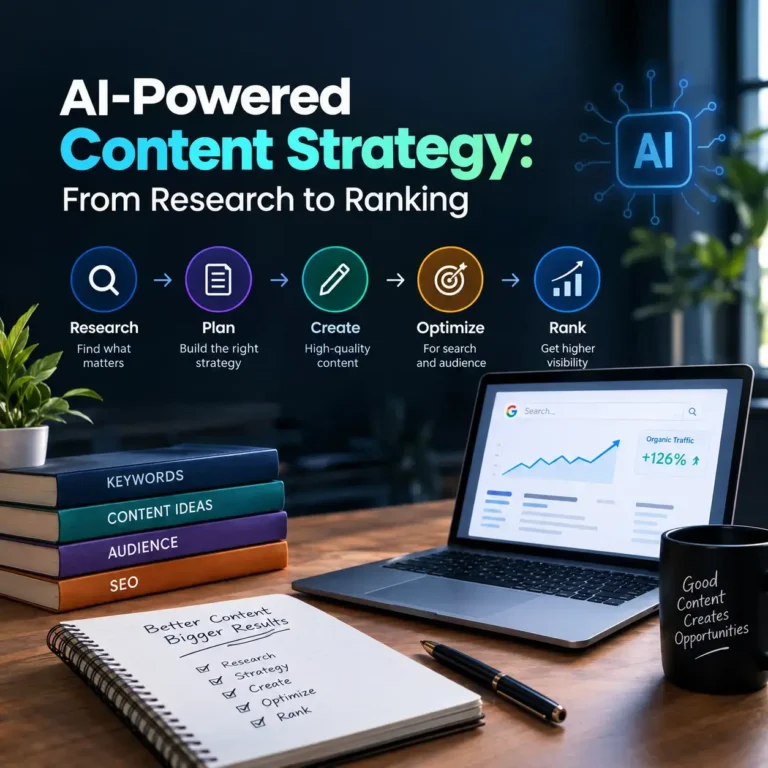
Content Strategy Based on Artificial Intelligence: From Research to Ranking
AI technologies have transformed the way of topics research, content creation, audience understanding, and web optimization. Nevertheless, the usage of AI-powered software to produce articles will hardly result in a content marketing solution. Companies should build an AI-based content strategy that would involve the combination of artificial intelligence and research of the target audience, search intent, SEO, human knowledge, and content quality and analytics.
The current trend is not about AI replacing marketers. On the contrary, AI should enhance the process of research, speed up monotonous work, discover new ideas, and help to make decisions based on strategic thinking and human knowledge.
From keyword research to content optimization and tracking of performance, AI can impact almost all stages of the content cycle. The main thing is to understand what should be done using AI and where human expertise is required.
AI Content Strategy Definition
The AI content strategy is a method for incorporating AI at various stages of content marketing.
Not just as a tool that allows producing texts automatically, but as a means for completing many tasks during the development process:
- Audience research
- Topic research
- Analysis of search intent
- Keyword research
- Content strategy planning
- Competitor research
- Content creation
- SEO optimization
- Content personalization
- Performance analysis
- Content updating
The goal here is not creating strategy additional content because of the speed of its production thanks to AI. The goal is the production of additional relevant and useful content.
Thus, the strategy must combine AI functions with research, insights, expertise, and editing.
How AI is Revolutionizing Content Marketing
Conventional content strategy marketing frequently involves lengthy processes of researching, planning, writing, editing, optimizing, and analyzing content performance.
AI can help save time on repetitive work.
AI will help marketers find common questions regarding the theme, sort out vast amounts of information, develop outlines for content, determine content gaps, and analyze trends among content pieces.
Thus, it becomes possible to divert marketing efforts from repetitive production to more strategic operations, such as planning, creativity, positioning, and understanding consumers.
But the speed alone will not become a competitive advantage because all companies can produce the same type of content. With AI content becoming easier to produce, the importance of originality, expertise, personal experience, and valuable content grows.
Step 1: Start with Audience and Market Research
Understanding one’s audience forms the foundation of any successful strategy.
While creating content, marketers need to find out the following:
- Whose the target audience is
- What issues they face
- What questions they ask
- What drives their decision-making process
- What prevents them from converting
- What they need to know before purchasing
- Where do they go on the Internet to conduct their research
AI will help in structuring the research, analyzing the feedback, classifying questions, and identifying the repeating patterns.
For example, a digital marketing agency can conduct customer queries and identify repeating patterns relating to SEO, social media advertising, website development, or lead generation.
All these topics can be used as content ideas.
In other words, the key thing here is that AI should help in processing the research and not in understanding the audience.
Step 2: Develop an AI-Fueled Keyword Strategy
Keyword research needs to go further than just gathering keywords with a lot of searches.
A sophisticated way to do this includes taking into account:
- Search intent
- Relevance to the topic
- Keyword difficulty
- Value for the business
- Content gaps
- Relationships semantically
- Conversion potential
- The user’s search journey
The use of AI could help organize related searches into topic clusters.
For instance, instead of writing a series of disconnected articles on each variation of a keyword, the marketer could understand what the topic is and which secondary questions need their own pages.
Step 3: Determine Search Intent
The search intent is one of the most important aspects of modern SEO practice.
Based on the goal of the searcher, the meaning of the same keyword may be completely different.
Types of search intent may include:
Informational – the user wants to receive some information.
Commercial – the user evaluates his or her options.
Transactional – the user is going to take some action or buy something.
Navigational – the user is looking for a specific website or a brand.
Machine learning models will be able to identify the search intent and recognize patterns in search queries.
But marketers should analyze search results manually since these results provide great insights into what users expect to see in this type of search query.
Step 4: Topic Clusters and Architecture
In the contemporary world of content strategy, one should create connections between pages and not publish standalone articles.
The structure of a topic cluster is usually comprised of:
Pillar Content –> Supporting Articles –> Internal Links –> Related Resources.
For instance, the website that specializes in digital marketing may feature a pillar page related to SEO along with other articles on technical SEO, keywords, backlinks, local SEO, and content strategy optimization, as well as on the search intent.
With the help of AI, one may uncover the connections between the topics and the suggested supporting content.
Nevertheless, the architecture should always be based on the search intent and topical relevance.
Step 5: AI for Creating a Content strategy Brief
Probably one of the most beneficial ways of using AI technology is in content strategy brief creation.
An excellent content brief might comprise such components as:
- Primary keyword
- Secondary keywords
- Search intent
- Target audience
- Heading ideas
- Questions to be answered
- Content gap analysis of competitor content
- Opportunities for internal linking
- Content format
- Conversion goal
It will give the writer a certain strategy to follow when writing the draft.
Step 6: Human Expertise Content Writing
While the use of AI technology will speed up the process of writing, publication of AI content without proper editing may bring some issues with the quality of such writing.
It would be better to use the following order:
Research → AI-created outline → Human expertise → AI-created writing → Human editing → Fact-checking → Search engine optimization → Publication
Human touch will be needed:
When creating personal stories
When giving an expert opinion
When conducting original research
When making case studies
When providing examples
When creating a brand voice
When dealing with specialized knowledge
When doing fact-checking
The goal is not to create “AI-free” content. The goal is to create valuable content.
Step 7: Content Optimization for Search & Discovery by AI
Traditional SEO works, but the search ecosystem becomes more complex.
Content can be found not only through traditional search engines, but through AI search, social media, and recommendation systems.
Therefore, the content strategy should be:
Well-structured
Intelligible
Semantic
Supported by credible information
Answering people’s questions
Relevant to the site authority
Good headings, clear explanation, informative title, internal links, information structure, and semantic relevancy can make your content intelligible both for users and search algorithms.
Step 8: Provide Original Information
The increase in AI-generated material has made original information even more important.
Firms could make a difference through:
- Surveys
- Customer insight
- Case studies
- Personal experiences
- Interviews
- Statistics
- Testing products
- Frameworks
Examples
For instance, instead of writing just another one on social media marketing, a marketer could examine results of his/her own campaigns and provide the reader with reasons for success and failure.
This sort of information is not easy to generate through generic AI tools.
Step 9: Utilizing AI for Content Optimization
After going through the process of publishing, one can use AI for helping in the analysis of the content strategy .
Here marketers can evaluate:
- Visibility of the content on search engines
- Click through rate
- Engagement rate
- Improved ranking
- Conversion rate
- Degradation of the content
- Links within the content
- Subtopics that were not covered
AI can further help in recognizing the sections that need clarity.
But it should be kept in mind that it should not only be optimized according to suggestions from an AI tool.
Step 10: Create a Content Refresh System
Article publication is just the start of the content cycle process.
Data and facts change. Search trends change. Competing sites post new data. SERP display formats change.
Therefore, a sound AI-based content strategy should include periodic audits.
The different types of content strategy could include:
Keep: Successful and up-to-date.
Update: Valuable, but needs additional data.
Improve: Has potential, but needs to be organized.
Merge: Replicates another site too closely.
Delete: Provides no valuable insight anymore.
AI technology could be used to detect possible content decay and find patterns in content performance, with marketers deciding what to update and merge.
AI Content Strategy and Keyword Cannibalization
The most critical SEO risk in creating multiple pages is targeting identical search intents on these pages.
AI helps in doing that by making it possible to create many pages with similar content strategy at once.
For instance, publishing multiple pages on topics such as “AI content strategy,” “AI-powered content strategy,” and “content strategy using AI” will make little sense if there is no difference in search intent behind those searches.
Marketers need to ask themselves the following before creating a page:
Is there another search intent behind this topic, or am I trying to create just another version of an existing page?
The Performance Measurement of Content Using AI Technology
The performance of any AI-assisted content strategy must not be evaluated based on the number of articles created.
Rather, other more relevant performance measures to use include:
- Organic traffic
- Visibility in keywords
- Number of search impressions
- Click-through rate
- Engagement
- Quality leads
- Conversion rate
- Assisted conversion
- Contribution to revenue generation
- Efficiency in content creation
While one page might receive high traffic without creating any business value, another less popular page with high relevance for visitors may generate much better results.
The Future of Content Marketing Driven by AI
AI will continue to shape content strategy marketing in terms of researching, personalizing, automating, searching, and analyzing.
However, the competitive edge will lie in balancing the efficiency of AI with human differentiation.
Companies producing huge amounts of generic content might have difficulties differentiating themselves. On the contrary, the companies that will utilize AI for processing information along with research, experience, and perspectives will create better content.
Thus, the future will probably not include the confrontation of AI and humans but rather human expertise enhanced by AI.
Final Thoughts
A solid AI content strategy is not about simply utilizing AI to generate your blog posts. Rather, it is an integrated process involving research, search intent analysis, keyword research, structure, development, optimization, metrics, and scaling up.
While AI can help you speed up and scale up, it is strategy that ensures your content is worth being looked at.
A winning strategy will be to leverage AI’s strengths such as researching, pattern recognition, organizing, ideation, automation, and analytics while leveraging the strengths of humans including originality, correctness, experience, creativity, and strategy.
In such a case, AI becomes not only an instrument for generating content but also a scalable content marketing strategy aimed at gaining visibility, trust, and business results.